AI Product Design. Building a networking coach for the part of the job search everyone said was hardest
Every person we surveyed named networking as their biggest job search challenge. I'm one of three on CareerCoachingPro's AI team building a coaching bot that lets clients practice it, trained on founder Carmelina Pietra's own methodology. Platform is decided; usability testing is next.
Role
AI Product Designer
Client
CareerCoachingPro
Team
Karina Morera, Jim Capone,
Tariq Cilione, Founder Carmelina Pietra
Timeline
April 2026 – Present
Tools
Claude, Slack, Mural, MindStudio

Overview
CareerCoachingPro coaches job seekers, career changers, and people trying to move up where they already work. Networking keeps coming up as the thing clients avoid, even though it's the tactic that actually works. My team is building an AI coaching bot that lets existing clients practice networking conversations in a low-stakes setting, grounded in Carmelina's real coaching frameworks rather than generic advice.
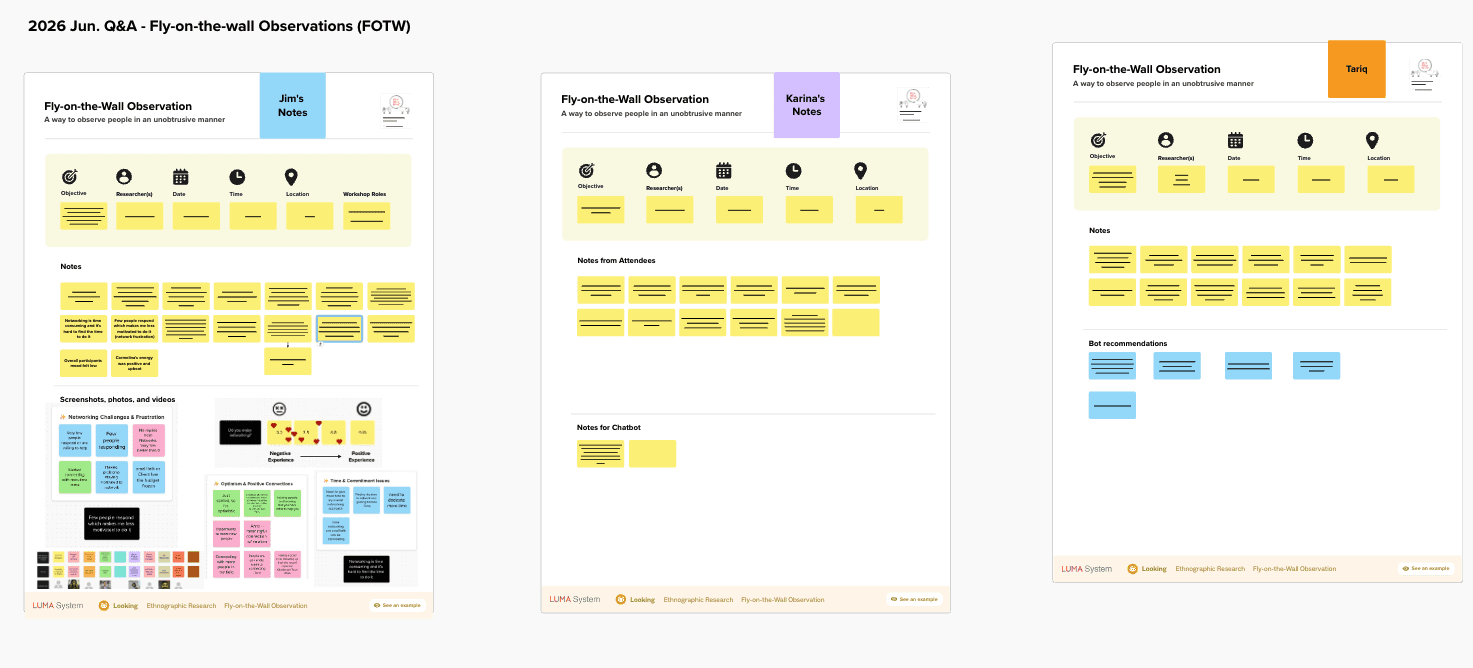
My goal: running the study that confirmed networking as the priority, mapping what the job search actually feels like emotionally, and working through what a platform needs to hold Carmelina's coaching voice without distorting it.
The Problem
100% of survey respondents named networking their biggest challenge, ahead of resumes and interviews
Over 75% rated landing a first interview a 9 or 10 out of 10 in difficulty
Most respondents were experienced overall but new to their specific niche
83% would consider an AI tool alongside coaching; 100% said no to AI replacing a human coach
My Process
1
Surfaced
assumptionsbefore researching anything, using a radar exercise to find where the team's beliefs disagreed.
2
Ran a 9-person survey
Rose/Thorn/Bud focus group on networking specifically, synthesized through affinity clustering
3
Found the real barrier
motivation collapse, not a skill gap. People know how to network, they burn out on the silence.
4
Mapped the emotional arc
of a job search, frustration to burnout to rebuilding confidence, to shape when the bot should intervene.
5
Evaluated 8 platforms
against a must/should/could-have list, trialed the top 2 head-to-head. MindStudio won
5
Now
usability testing and real client interviews, both in progress.
My Process
1
Surfaced
assumptionsbefore researching anything, using a radar exercise to find where the team's beliefs disagreed.
2
Ran a 9-person survey
Rose/Thorn/Bud focus group on networking specifically, synthesized through affinity clustering
3
Found the real barrier
motivation collapse, not a skill gap. People know how to network, they burn out on the silence.
4
Mapped the emotional arc
of a job search, frustration to burnout to rebuilding confidence, to shape when the bot should intervene.
5
Evaluated 8 platforms
against a must/should/could-have list, trialed the top 2 head-to-head. MindStudio won
5
Now
usability testing and real client interviews, both in progress.
Design Principles (So Far)
Teacher first, advisor second
The bot walks people through the reasoning, it doesn't just hand over conclusions.
Design against motivation collapse
Early, visible wins matter more than more advice, since burnout, not skill gaps, is the real barrier.
Honest over encouraging.
f something isn't working, the bot says so plainly instead of softening it.
Practice without real stakes.
A safe place to rehearse networking where failure doesn't cost anything real.




Key Product Design Decisions
Persona-adaptive
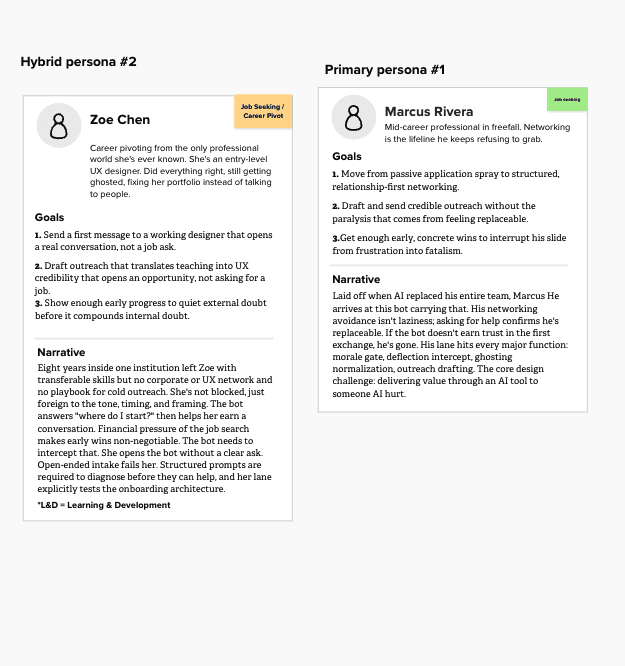
Tone and approach shift based on who's talking, someone just laid off needs something different from someone advancing in place.
Human in the loop
Carmelina reviews conversations and steps in where the bot shouldn't go alone.
Trial over paper specs
Carmelina's voice, teacher-first, plainspoken, direct, doesn't show up in a feature table. Only in an actual conversation.

Results
+12 %
Increase in positive reviews mentioning ease-of-use
Faster
More intuitive
booking flow
Mobile
Significantly improved for majority users
Reflections
Learnings
Backend constraints shaped design decisions (e.g., spacing increments for easier coding)
Early design systems save time and reduce rework
Simplifying complex content into digestible
UI is essential
Next Steps
Post-booking onboarding (emails, facility tours)
Explore dynamic pricing and mobile app features
Test community engagement features for boaters
Personal Growth
Strengthened Figma and component-based design skills
Improved collaboration with developers
Honed problem-solving as the solo designer managing a full redesign






“ When my team hired Karina to design our UI/UX, we were pleasantly surprised by her research-based approach to designing our site, checkout process, and customer portal. Her direction, Figma wireframes and keen eye for detail were invaluable in helping my team focus on coding.
Beyond creating beautiful, research-based designs for our platforms, Karina worked with me to make them modular and reusable across multiple sites. This allowed us to move quickly and reduce developer overhead without compromising the quality of our product”

Sami Syed
Software Developer- Team Lead, Teutsch Partners/ Columbia Crossings
Role
AI Product Designer
Client
CareerCoachingPro
Team
Karina Morera, Jim Capone,
Tariq Cilione, Founder Carmelina Pietra
Timeline
April 2026 – Present
Tools
Claude, Slack, Mural, MindStudio
Overview
CareerCoachingPro clients avoid networking even though it's the tactic that works. My team is building an AI coach that lets them practice it low-stakes, grounded in Carmelina's real frameworks. My part: the research behind it, the experience map, and the platform evaluation.
My goal: give CCP clients a low-stakes way to practice the exact thing they told us was hardest, in a voice that actually sounds like Carmelina's coaching, not generic advice, before this ever reaches a real client.
CareerCoachingPro clients avoid networking even though it's the tactic that works. My team is building an AI coach that lets them practice it low-stakes, grounded in Carmelina's real frameworks. My part: the research behind it, the experience map, and the platform evaluation.
My goal: give CCP clients a low-stakes way to practice the exact thing they told us was hardest, in a voice that actually sounds like Carmelina's coaching, not generic advice, before this ever reaches a real client.
The Problem
100% of survey respondents named networking their biggest challenge, ahead of resumes and interviews
Over 75% rated landing a first interview a 9 or 10 out of 10 in difficulty
Most respondents were experienced overall but new to their specific niche
83% would consider an AI tool alongside coaching; 100% said no to AI replacing a human coach
My Process
1
Surfaced
assumptionsbefore researching anything, using a radar exercise to find where the team's beliefs disagreed.
2
Ran a 9-person survey
Rose/Thorn/Bud focus group on networking specifically, synthesized through affinity clustering
3
Found the real barrier
motivation collapse, not a skill gap. People know how to network, they burn out on the silence.
4
Mapped the emotional arc
of a job search, frustration to burnout to rebuilding confidence, to shape when the bot should intervene.
5
Evaluated 8 platforms
against a must/should/could-have list, trialed the top 2 head-to-head. MindStudio won
5
Now
usability testing and real client interviews, both in progress.
Design Principles (So Far)
Teacher first, advisor second
The bot walks people through the reasoning, it doesn't just hand over conclusions.
Design against motivation collapse
Early, visible wins matter more than more advice, since burnout, not skill gaps, is the real barrier.
Honest over encouraging.
If something isn't working, the bot says so plainly instead of softening it.
Practice without real stakes.
A safe place to rehearse networking where failure doesn't cost anything real.
Key Product Design Decisions
Persona-adaptive
Tone and approach shift based on who's talking, someone just laid off needs something different from someone advancing in place.
Human in the loop
Carmelina reviews conversations and steps in where the bot shouldn't go alone.
Trial over paper specs
Carmelina's voice, teacher-first, plainspoken, direct, doesn't show up in a feature table. Only in an actual conversation.
Reflections
Where Things Stand
Platform decided. Usability testing and client interviews in progress. No launch yet.
Learnings
We're keeping vendor relationships separate by product. Still working with Action Potential for the intake bot, but this one needed a different platform.
Our research found the real issue was motivation collapse, not a skill gap.
Doing real research before building anything paid off. It also made me realize there were more emotional components to this that were missed initially.
Next Steps
Recruit more participants, and more diverse ones, for the next round of research
Finish usability testing and the real client interviews already in progress.
Keep designing against public skepticism toward AI, not around it, since that skepticism showed up directly in the survey.
Personal Growth
Explaining AI through an HCD lens, to my team and eventually to Carmelina, is harder than I expected. Still working on it.
Learning to pick the right research method for the actual problem instead of defaulting to the one I know best.
Users not knowing what they want isn't a failed research question, it's a real finding. Learning to design around that instead of wishing it away.